
4.0 KiB
title, description, date, category, author, cover, draft
| title | description | date | category | author | cover | draft |
|---|---|---|---|---|---|---|
| Testowy Artykuł - Tytuł | Testowy artykuł - opis | 2026-07-23 | news | CTAO | /uploads/UAE_Event.jpg | true |
Artykuł testowy — treść skopiowana z newsa CTAO: Preparing the Montpellier Raman LIDAR Calibration System for CTAO-South.
An essential part of the CTAO telescopes' detectors is situated well above their actual mechanical structure: the Earth's atmosphere. It is there that high-energy gamma rays interact with atmospheric molecules, giving rise to a cascade of particles that produce faint flashes of Cherenkov light. Because atmospheric conditions dictate how this light reaches the ground, it is fundamental to characterise our skies continuously — a task performed by devices known as Raman LIDARs.
How a Raman LIDAR works
- The instrument fires powerful laser pulses into the atmosphere — two beams of different wavelengths at once, covering the spectrum of Cherenkov light seen by the telescopes.
- A telescope collects the light that bounces back.
- By measuring the exact time it takes for this light to return, it calculates the amount of aerosols present at different altitudes.
- The backscattered signal is separated into four channels — one dedicated to Raman-scattered light, produced when photons interact with atmospheric nitrogen and shift slightly in wavelength.
This configuration provides scientists with highly detailed atmospheric profiles, allowing them to pinpoint various aerosols.
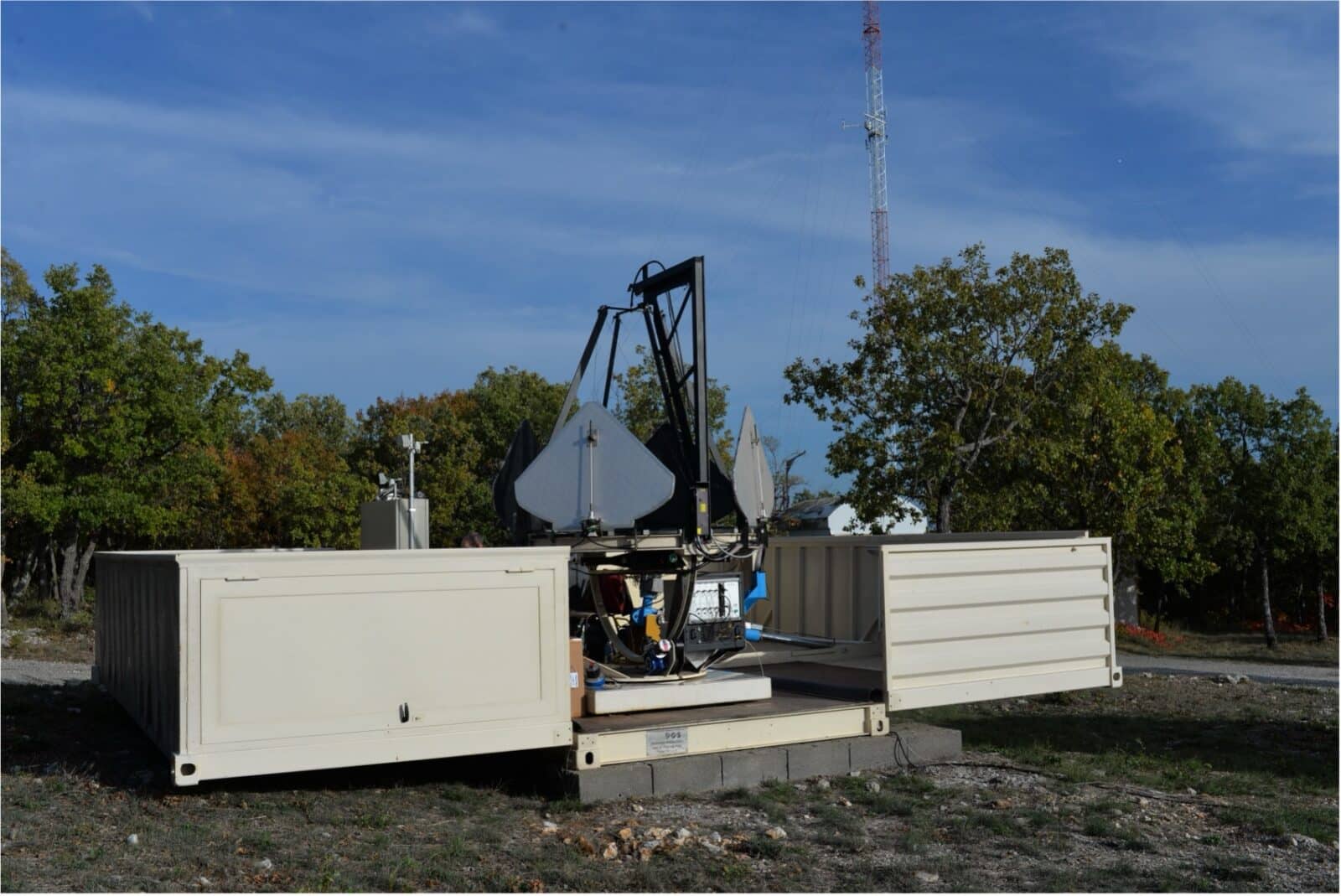 Zdjęcie testowe — kliknięcie prowadzi do powiązanego newsa CTAO.
Two instruments, two sites
| Instrument | Array site | Location |
|---|---|---|
| Barcelona Raman LIDAR (BRL) | CTAO-North | La Palma, Spain |
| Montpellier Raman LIDAR (MRL) | CTAO-South | Atacama Desert, Chile |
The MRL is being developed by researchers from the In-Kind Contribution (IKC) team at LUPM (Laboratoire Univers et Particules de Montpellier), France. It shares a similar foundational design with its northern counterpart — a large 1.8-metre mirror, a high-specification laser and a bespoke detection module — but what truly sets it apart is its in-house technology:
- a specialised timing protocol for the light sensor, capturing atmospheric profiles at altitudes as low as 230 metres;
- an automated alignment and calibration protocol for the entire detection chain, reducing human intervention to a minimum — a tremendous advantage in the remote, high-altitude Chilean desert.
Validated against a European reference network
Recently, the MRL team concluded a 24-month testing phase at the Observatoire de Haute-Provence in France. Atmospheric profiles were recorded, analysed and validated against data from LATMOS, a reference site of the European Aerosol Research Lidar Network (EARLINET). The results confirmed that all individual elements of the LIDAR performed successfully.
Next step: the design review
These evaluations propel the project toward the Critical Design and Mechanical Review (CDMR) — a comprehensive evaluation by the CTAO Central Organisation, verifying that the instrument's design is mature, safe and ready for final construction. In the near future, a panel of experts will visit France to officially initiate the review; passing it is mandatory for installation at CTAO-South.
An observatory requires many different pieces working in harmony. Beyond the telescopes, calibration and monitoring instruments like the MRL are necessary to guarantee the highest quality data.